
Key Points
- There is no universal answer — whether leaving your AC on all day saves money depends on your home’s insulation quality, AC efficiency (SEER rating), thermostat type, and Georgetown’s specific humidity levels.
- According to the U.S. Department of Energy, setting your thermostat to around 78°F when away from home can save the average family about 11% on annual cooling costs — making programmable thermostats the single highest-impact energy-saving tool available.
- In Georgetown and Southern Georgia’s coastal climate, humidity is as important as temperature — leaving the AC off for extended periods allows indoor humidity to rise, making the home feel warmer and often prompting homeowners to lower the thermostat further, wasting more energy.
- Programmable and smart thermostats solve this problem directly — scheduling the AC to maintain a higher temperature while you’re away, then returning to comfort temperature before you arrive, avoids both excessive heat gain and the cost of running continuously at full power.
- Modern AC units with SEER ratings of 17 or higher use significantly less electricity to achieve the same cooling power as older units — making the leave-on-vs-turn-off decision less costly in either direction.
- Every AC start-up places demands on the capacitor and draws a surge of electricity — but a system running continuously at a low setting can still consume more total energy than a well-scheduled system that runs efficiently in shorter cycles.
- Contact Georgia Air Cooling & Heating for expert advice on energy efficiency, AC maintenance, and AC replacement throughout Georgetown and the Richmond Hill area.
As your energy costs and all other household expenses creep upwards, the only relief might come from reliable cooling. The heat and humidity of Georgetown’s summers certainly don’t seem to be taking a break anytime soon — so what can locals do to ease the pressure and cost-effectively cool down?
If you’re looking at last month’s energy bill, you might ask: “Is it more energy-efficient to leave my AC on all day?” If so, you might be surprised that this question is not always easy to answer. There is value in avoiding substantial heat gain and humidity that impair your indoor comfort, but is that enough to mitigate the strain on your cooling system?
In this guide, Georgia Air Cooling & Heating — Georgetown’s skilled AC repair technicians — discuss the most effective ways to leverage your cooling system during hot weather.
The Basics of AC Energy Use in Georgetown, GA
Air conditioning consumes copious amounts of energy at times. Several components in your cooling system require substantial electrical power to compress and circulate refrigerant, expel humidity and heat outdoors, and distribute conditioned air. All systems consume energy as they run — so wouldn’t running the air conditioner continuously just mean the system uses more electricity?
Every system start-up places demands on your system’s capacitor and consumes more electricity than running at a lower speed. However, as Georgetown homeowners zero in on ways to reduce utility bills, it might be helpful to point out that these systems still use the most electricity when they are actively cooling and circulating air.
While there is no clear-cut answer as to whether to let your home heat up or maintain a continuous temperature, these key factors inform your strategy:
Home Insulation: Well-insulated homes are more resistant to heat when an air conditioner is not actively running. Lower heat gain provides greater flexibility, as it takes less time and energy to restore your desired indoor temperature when you return home.
Air Conditioning Efficiency: Modern cooling systems sport higher Seasonal Energy Efficiency Ratio (SEER) ratings. Higher SEER ratings cool inside air faster and more efficiently than comparable older units — meaning these units use less electricity to bring down the indoor temperature anytime you switch them on.
Thermostat Control: How you use your thermostat has a substantial impact on energy efficiency. Thermostat scheduling — discussed in detail below — is one of the most impactful strategies available to Georgetown homeowners.
Is It More Energy-Efficient To Leave the AC On While You’re Away?
It’s the right idea to say that leaving your air conditioning system on all day at a constant temperature will prevent heat gain. In that way, avoiding the work of bringing down warm temperatures might seem like a solid strategy — but going that route could come at a cost. It takes some trial and error.
In some systems, it’s possible that you’ll pay more to maintain a lower temperature when you are not home than you will by just switching on the air conditioner when you need cool air. Your air conditioner works by removing indoor heat and humidity. If you leave it on throughout the day, it will continue to perform that work and use energy to do so.
However, technology is changing. The United States Department of Energy has also reported that setting a thermostat to around 78°F when you are away from home might save the average family about 11% on annual energy costs. Of course, maximizing your savings will require finding the perfect air conditioner settings for your space.
A practical starting point for Georgetown homeowners: Rather than choosing between “on all day at 72°F” or “off completely,” the most energy-efficient approach for most homes is a middle ground — setting the thermostat to 78–80°F while away rather than turning the system off entirely. This prevents the humidity buildup that makes homes feel significantly warmer than the actual temperature, while avoiding the energy cost of maintaining peak cooling in an empty house.
Enter Programmable Thermostats
Why are modern HVAC systems boosting efficiency so much? It helps that they have the capacity to use programmable thermostats — likely the single best tool for maximizing energy efficiency.
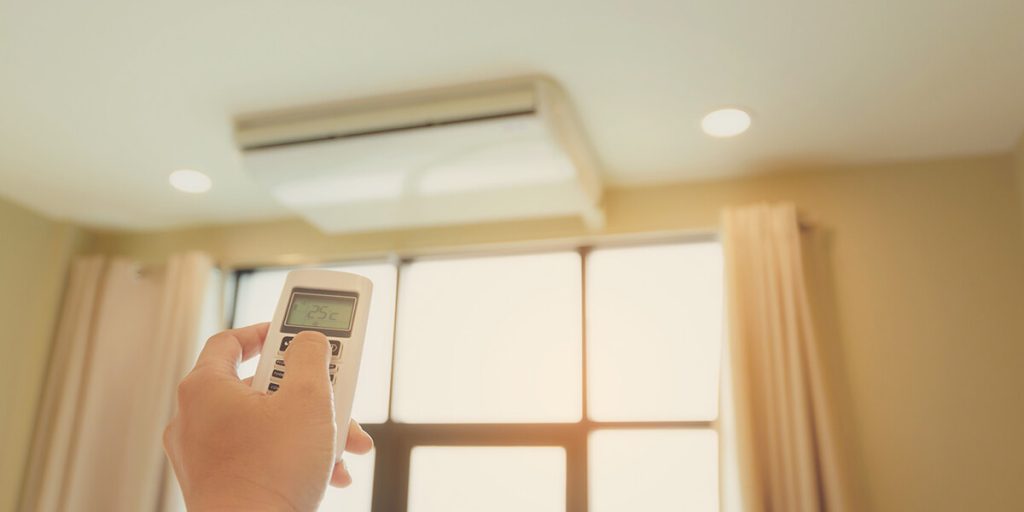
By using effective thermostat scheduling, you can automate or remotely control temperature regulation in your home. Program your thermostat to reach a comfortable temperature a few minutes before you arrive home. As your schedule or weather conditions change, you can manage your thermostat from anywhere via an app.
How to set up an effective thermostat schedule for Georgetown’s climate:
- Away hours (daytime) — set to 78–80°F; this prevents excessive humidity buildup while avoiding the cost of full cooling in an empty home
- Pre-arrival — program the system to begin cooling 30–45 minutes before you typically arrive home; most smart thermostats can learn your schedule and adjust automatically
- Evening/occupied hours — set to your preferred comfort level, typically 72–75°F
- Overnight — many families sleep comfortably at slightly higher temperatures (75–78°F) with ceiling fans, saving energy during overnight hours
- Vacation mode — when away for multiple days, 82–85°F is typically sufficient to prevent humidity and mold issues without running the system at full cooling power throughout your absence
The Impact of Humidity on AC Efficiency in Georgetown, GA
In Georgetown and around Southern Georgia, humidity levels always play a major role in how comfortable your home feels. Air conditioners don’t simply “cool” indoor air — instead, they remove ambient heat and excess humidity to reduce indoor temperatures. This is why they also improve your indoor air quality.
When your air conditioner remains off for extended periods, indoor humidity levels naturally rise. That makes it feel warmer inside, even when the temperature setting hasn’t changed. Many homeowners lower the thermostat settings at this point — but that only increases your system’s energy consumption.
Some people swear by maintaining a consistent but higher thermostat setting when they are away to prevent excessive humidity buildup. This move also reduces the risk of interior mold and mildew growth, which is better for your health.
Why humidity management is especially critical in Georgetown: Chatham County and the surrounding coastal area consistently rank among the most humid regions in the United States, with outdoor relative humidity regularly exceeding 80–90% during summer months. When a home’s AC is off and Georgia’s humid outdoor air infiltrates through doors, windows, and building envelope gaps, indoor humidity can rise to levels that feel oppressive within a few hours — and that create conditions favorable to mold growth within 24–48 hours. This is the strongest argument for maintaining a modest level of AC operation rather than fully turning off the system during prolonged absences. If indoor air quality or mold concerns are present in your home, Georgia Air’s indoor air quality services can provide a full assessment and solutions.
The Benefits of Modern HVAC Units with High SEER Ratings
Is it more energy-efficient to leave your AC on? If you’re upgrading to a modern air conditioning unit, you’ll find that the high SEER ratings available are a far cry from the electricity-guzzling models of the past.
High-efficiency cooling systems with SEER ratings of 17 or higher:
- Use less energy to provide the same cooling power as older units
- Cost less to operate month after month, year after year
- Have a lower environmental impact due to reduced energy consumption
Modern high-SEER cooling systems also feature smart thermostats and variable speed fans. Variable speed operation reduces the number of start-stop cycles your unit undergoes to maintain the desired temperature — one of the most significant contributors to improved efficiency and reduced wear.
Is your current unit limiting your savings? If your AC is more than 10–15 years old, its SEER rating may be as low as 8–10 — compared to today’s standard minimum of 14 and premium systems reaching 20+. The energy cost difference between an old low-SEER unit and a modern high-SEER unit can offset much of the installation cost over just a few years of operation in Georgetown’s long cooling season. Georgia Air’s AC replacement and installation service can help you evaluate whether upgrading makes financial sense for your home.
Additional AC Energy-Saving Tips
Consider these energy-saving tips to further reduce cooling costs and improve energy efficiency.
Regular Cooling Maintenance: Air conditioners in our region get a serious workout year-round, so routine AC maintenance is critical for maintaining peak energy efficiency. HVAC professionals can provide maintenance that includes internal system cleaning, checks for proper refrigerant levels, leak detection, inspection of coils and system components, filter checks, and more. These regular tune-ups improve cooling performance and reduce energy consumption.
Maximize Fan Use: Circulating air naturally feels cooler and more comfortable. Ceiling fans and floor fans help distribute cool air more evenly — and with fans, you can set the thermostat a few degrees higher and still feel just as comfortable.
Seal Leaks and Insulate: Heat gain is your greatest enemy — so consider insulation as a tool that does the same job as the AC without the energy cost. Effective insulation and sealing on windows and doors won’t allow hot air to pour into your indoor space.
Shade Your Home: Radiant solar heating creates surprising indoor heat gain. Use blinds, curtains, or reflective window films to block direct sunlight — especially from south and west-facing windows. Consider landscaping with trees and shrubs for natural shade, along with awnings and pergolas.
Maximizing the Lifespan of Your AC Unit
In weighing your options for running your AC efficiently, another important consideration is how your cooling system usage affects the unit’s effective lifespan. Here are things to keep in mind:
- Keep filters clean — during warm weather, check your unit’s filter at least once a month; change it when dirty or clogged, and install a fresh filter at least every 90 days
- Keep the area around the outdoor unit tidy — no grass, vegetation, or debris should crowd the outdoor unit or obstruct airflow around the vents
- Keep thermostat settings consistent — setting the unit to an extremely low temperature creates more wear and tear than cycling it on and off during the day; dramatic temperature swings stress the compressor
- Consider upgrading if the unit is 10–15+ years old — older units are significantly less efficient and more prone to failure during peak demand
Key Takeaways
The answer to “should I leave my AC on all day?” depends on your home’s insulation, your system’s SEER rating, and Georgetown’s specific humidity conditions. The DOE confirms that setting thermostats to 78°F when away saves about 11% on annual cooling costs — making programmable and smart thermostats the most impactful single investment for energy savings. In Georgetown’s coastal humidity, fully turning off the AC for extended periods risks humidity buildup that feels worse than the temperature number suggests and creates mold risk within 24–48 hours. The best strategy for most Georgetown homes is maintaining 78–80°F while away rather than full-off, using thermostat scheduling to return to comfort temperature before you arrive home. Regular AC maintenance, proper insulation, ceiling fans, and window shading all reduce the overall cooling load. If your system is 10–15+ years old, upgrading to a high-SEER unit may save more money long-term than any thermostat strategy. Contact Georgia Air Cooling & Heating for expert guidance on energy efficiency throughout Georgetown and the Richmond Hill area.
Count on Georgia Air Cooling & Heating for Comprehensive HVAC Services in Georgetown, GA
Your decision to leave a cooling system on all day includes several variables that impact this very personal decision. Most homes in Georgetown find thermostat scheduling is the most effective strategy to pay for cooling power as and when you need it. Georgia Air Cooling & Heating would be happy to help you work through this decision based on your individual needs and the space you want to cool.
Whether you need expert advice on energy efficiency, AC maintenance, or AC replacement and installation services — call Georgia Air Cooling & Heating today for all-around home comfort throughout Georgetown, GA!